
- Over nearly ten years, the Caatinga biome managed to remove an average of 527 grams of carbon per square meter, or 5.2 tons per hectare per year, from the atmosphere.
- The Water and Carbon Dynamics Observatory compared data from the Brazilian biome to those of dry regions in the United States, Canada, Mexico, Spain, Australia, ecosystems in South America, and the African Sahel region.
- Data places the Caatinga among the most efficient carbon sinks among the world’s dry forests.
- Rain was the most important factor for carbon exchange in the biome.
- Study opens avenues for carbon credit programs in the region.
Compared to 30 other dry locations around the world, the Caatinga demonstrates high efficiency in carbon use, even surpassing the Amazon rainforest. This was the result of groundbreaking research investigating carbon flows in the biome, considering diverse climate, soil, and vegetation conditions. The objective is to quantify and evaluate the seasonal and annual evolution of carbon exchange in the Caatinga, a biome exclusively found in Brazil.
The work, led by the National Observatory of Water and Carbon Dynamics in the Caatinga Biome ( OndaCBC ), involves a multidisciplinary network of researchers from various institutions, such as Embrapa Semiárido (PE), Federal University of Rio Grande do Norte ( UFRN ), Federal University of Pernambuco ( UFPE ), Federal University of Agreste de Pernambuco ( UFAPE ), Federal University of Campina Grande ( UFCG ), and the National Institute of the Semi-Arid ( INSA ). Studies conducted over almost ten years revealed that the Caatinga biome managed to remove an average of 527 grams of carbon per square meter or 5.2 tons per hectare from the atmosphere.
Tropical forests that are seasonally dry, such as the Caatinga, play a crucial role as carbon sinks, that is, natural reservoirs that absorb and capture CO₂ from the atmosphere, reducing its presence in the air, with implications for local, regional, and global climate. These processes are influenced by the spatio-temporal distribution and volumes of rainfall, which directly affect vegetation cover.
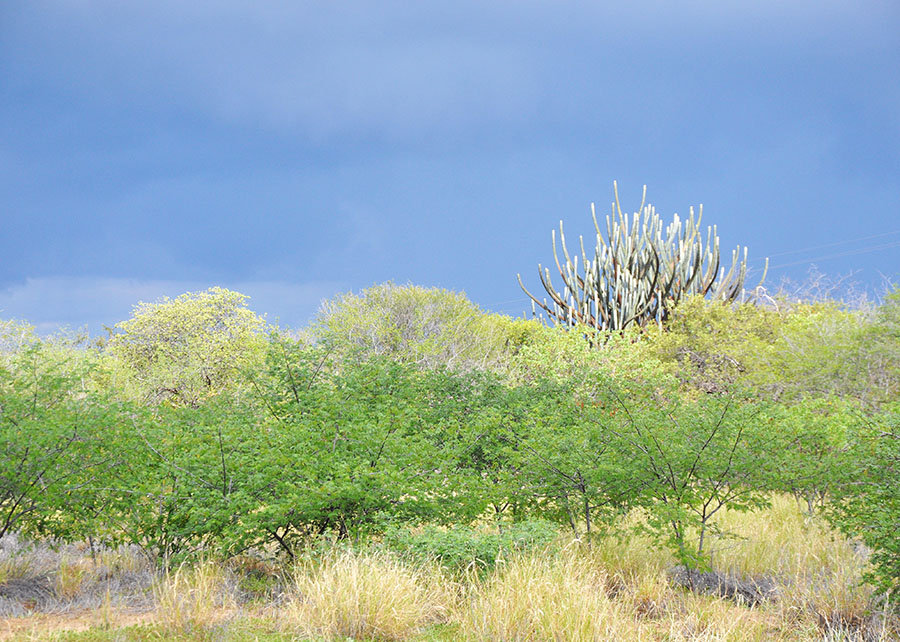
Bezerra adds that, in the Caatinga, temperature, radiation, and humidity remain practically constant over time, with small variations that do not significantly affect CO2 exchange. However, it has been found that, in this biome, rainfall, even in small amounts, is the most important factor for carbon exchange. “This is because rainfall stimulates plant growth, thus increasing the biome’s capacity to absorb CO2 from the atmosphere, acting as a highly effective sink for this gas,” he concludes.